First author | 2026 | Revising for journal submission | Not yet published
Laboratory of Molecular and Thermodynamic Modeling at the University of Maryland
I developed a 22.53M-parameter Python/PyTorch backbone that combines frozen features from a 600M-parameter ESM++ protein language model with RDKit molecular graphs and a D-MPNN (directed message-passing neural network). Trained with CUDA BF16 mixed precision, it predicts 3 kinetic parameters: turnover, Michaelis, and inhibition constants.
Molecule-conditioned cross-attention and shared latent actions connect two JEPA-style objectives for binding and reaction, with contrastive losses and SIGReg-style regularization. A 406-parameter label-memory module uses sequence-cluster exclusion to selectively correct turnover predictions. No reaction products are required at inference.
I began this work full-time in summer 2026 and continue this fall withProfessor Jeffery B. Klauda and PhD student Kinjal Mondal.
Outperformed retrained CatPred, published in Nature Communications (2025), in 18 of 18 Heldout/OOD99 metric point estimates and 41 of 48 across all supplied cohorts.
Turnover OOD99 R^2: 0.395 vs. CatPred's 0.323 on the same 348 rows.
Drug-discovery relevance: predicting enzyme inhibition constants connects this work to inhibitor evaluation. On 1,193 held-out inhibition measurements, LANCE reduces log10 MAE from 0.865 to 0.788, an 8.9% reduction versus retrained CatPred.
Currently running 12 controlled ablation experiments via Slurm on UMD's Zaratan HPC cluster following mentor feedback: 6 loss configurations, 2 paired seeds, and 3 memory comparisons. These test which objectives and retrieval choices contribute to the gains. Results are pending.
0.848 AUC versus 0.719 for the baseline on the paper's 30-patient held-out test set.
My contribution: a custom 2.5D ResNet50 classifier combining seven MRI slices, three input channels (intensity, Frangi vesselness, and local variance), and learned slice attention with max pooling.
93 aligned book-audiobook pairs to study how narrative text predicts pitch, volume, and speaking rate.
Across 24 evaluation books, predictions correlated more closely with human narration than a commercial text-to-speech system for pitch in 22 books and volume in 23.
Earlham ITS & System Administration team | Primary maintainer
I collaborate directly with Earlham ITS department to build and maintain Earlham's chat platform, a custom LibreChat deployment in internal beta. As primary maintainer, I support about 150 daily users, with Earlham SSO sign-in and occasional contributions from two teammates.
Local LLM inference: migrated from Ollama to llama.cpp across 2 Linux nodes and 4 NVIDIA A5000 GPUs, with replica routing, failover, and GPU memory allocation for models up to 80B parameters.
Self-service API keys: model selection, expiry, and revocation let students use campus-hosted models in their own tools without a laptop GPU.
Isolated coding workspaces: separate filesystem identities, 15 GiB per-user quotas, network restrictions, read-only system files, and a 120-second command timeout.
Service operations: a $3 daily online-model budget per user, MongoDB backups, and database recovery tested in isolated containers.
Student systems administrator | February 2025-present
I administer Linux servers, scientific software, and dependencies for Earlham's STEM coursework and research. My main focus is Faraday's GPU computing environment.
PyTorch and TensorFlow: separate Conda environments with CUDA 12.4 and Jupyter kernels, avoiding framework dependency conflicts.
Python 3.13 and environment modules: shared installations on Faraday and Pollock, with dependency pinning to preserve GPU compatibility.
Wildcard TLS renewal: automated with Certbot, RFC 2136 DNS challenges, and BIND TSIG authentication.
NFS shared storage: restored persistent home-directory mounts on 2 backup servers, Rossum and Dijkstra.
Electromagnetism, Waves and Optics (With Calculus) (PHYS 235)
Calculus B
In this Earlham campus job, I hold tutoring hours every Wednesday, 7-9 p.m. I've helped several students understand equations more clearly and apply them to course problems.
My Calculus A TA position (teaching assistant) ended in May 2026. I chose to explore physics tutoring rather than continue as a TA.
From cameras to robot-ready scenes
Perception and Robotics Group, UMD | Summer 2025 With Professor Yiannis Aloimonos and Pavan Mantripragada
My work at UMD took me from pixel-level matrix operations to structure from motion (SfM), COLMAP, Gaussian Splatting, and RLBench. I started by implementing Gaussian filters, image derivatives in the x and y directions, and edge detection from scratch, without image-processing libraries.
A 3x3 fundamental matrix constrains a point's match in the second image to a line. My write-up derives this matrix from at least 8 independent correspondences and explains two uses of singular value decomposition (SVD): finding a unit-length least-squares solution, then enforcing the rank-two constraint required by epipolar geometry.
Understanding the linear algebra helped me see why each step in the reconstruction code was needed.
Epipolar geometry: a point in one image constrains its match in the other image to a line.
The practical connection: in my reconstruction experiments, standing still and rotating the camera did not provide enough parallax. Translation supplies the viewpoint change needed to recover depth. Understanding the geometry helped me explain why the capture setup mattered, beyond whether the code ran.
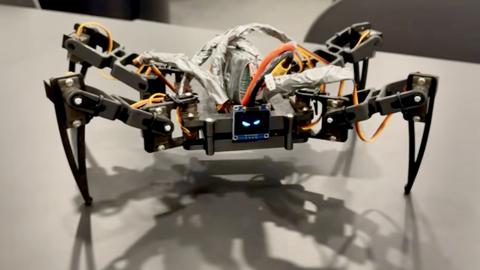
NYX-V quadruped
I built a 12-degree-of-freedom quadruped with a custom 3D-printed chassis and an ESP32 controller. The firmware uses C++ and FreeRTOS, separating Wi-Fi and inverse-kinematics control across the ESP32's two cores. Inverse kinematics converts desired foot positions into joint angles.