LANCE: learning enzyme kinetics
Bach Pham | First author
With Professor Jeffery B. Klauda & PhD student Kinjal Mondal
Laboratory of Molecular and Thermodynamic Modeling
University of Maryland | Revising for journal submission | Not yet published
Enzyme measurements are sparse and depend on experimental conditions. LANCE predicts kcat, Km, and Ki with one shared architecture and three prediction heads.
October 2026: Professor Jeffery B. Klauda and PhD student Kinjal Mondal reviewed the manuscript and requested more ablation evidence. I am currently running 12 controlled ablation experiments on UMD's Zaratan HPC cluster under energybio-eng. Results are pending. See the study design -->
One model, three predictions
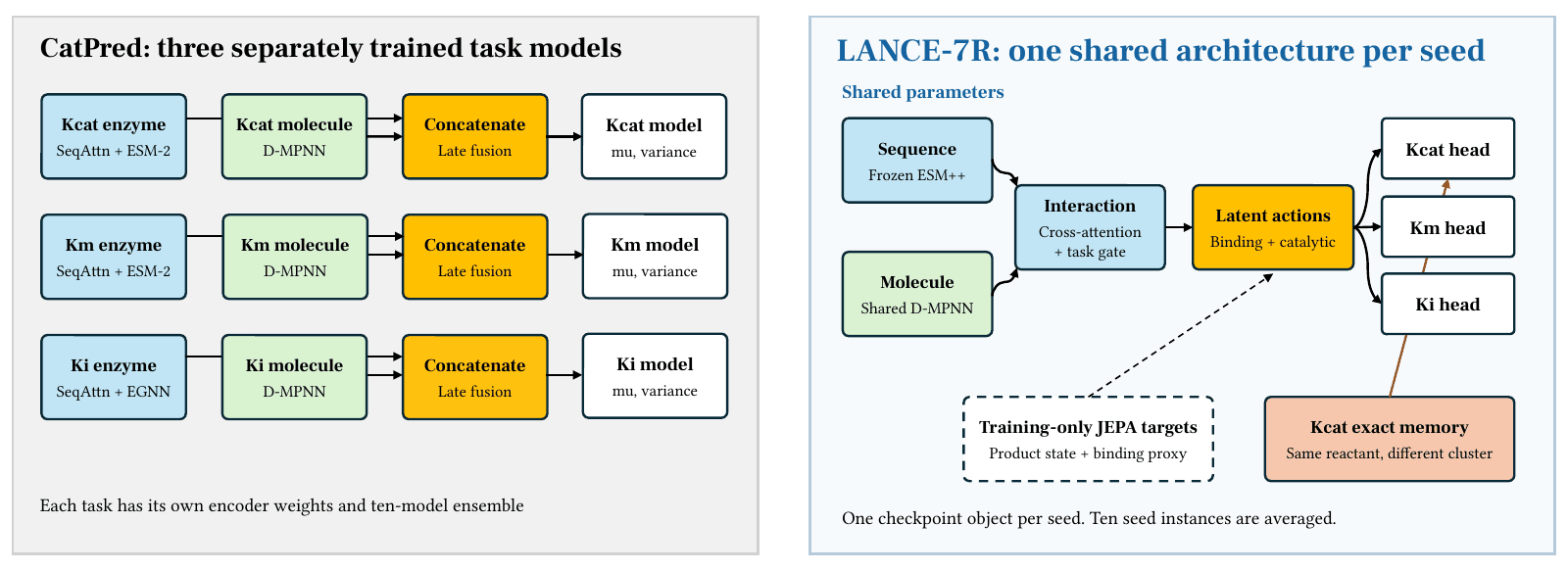
From protein sequences and SMILES to shared features
- Frozen ESM++ protein features. I cache residue embeddings from the 600M-parameter ESM Cambrian model through ESM++. Each residue has 1,152 features, projected to 512 dimensions in the learned backbone. The protein language model stays frozen, so training reuses its features without backpropagating through 600M parameters.
- RDKit graphs and a D-MPNN. RDKit converts molecular SMILES into atom-bond graphs. I adapted CatPred's directed message-passing encoder to produce 300-dimensional atom states, then project them to 512 dimensions. Reactants, substrates, inhibitors, and training-only products share the same encoder weights.
- Early molecule-conditioned cross-attention. Four query tokens derived from the molecule attend to enzyme residues through 8 attention heads. A learned task gate controls how much this interaction changes the global enzyme representation, before the kinetic prediction heads.
Two JEPA objectives, shared latent actions
Joint-Embedding Predictive Architecture (JEPA)-style learning guides two latent routes with different roles. Two shared 64-dimensional action vectors combine enzyme-interface and molecule features. A shared residual adapter uses task embeddings to adjust the actions for each endpoint, then projects them to update separate binding and catalytic representations:
- Reaction JEPA predicts a latent displacement from a stop-gradient reactant anchor toward a stop-gradient product target. Smooth-L1 and in-batch contrastive losses supervise the predicted state and displacement. Products supply training targets, not inference inputs; rows without products still receive kinetic supervision.
- Binding JEPA trains on Michaelis and inhibition examples using a stop-gradient target formed from the molecule and enzyme-interface states. It provides product-free self-consistency supervision, rather than a measured enzyme-ligand complex or an experimentally validated binding state.
SIGReg-style regularization matches randomly projected representation distributions to a standard Gaussian to discourage collapse. A separate squared-cosine penalty discourages the two action vectors from becoming copies. These objectives guide the representations; the pending ablations test how much they contribute to prediction quality.
Training the predictor
The 22.53M-parameter Python/PyTorch backbone uses CUDA BF16 mixed precision. That parameter count excludes the frozen 600M protein feature extractor. Three heteroscedastic regression heads predict a mean and log variance using beta-weighted Gaussian negative log likelihood. Temperature and pH enter with missing-value flags, so an absent measurement is distinguishable from zero.
- Task-balanced batches of 256: approximately 86 turnover, 85 Michaelis, and 85 inhibition examples per batch.
- AdamW and gradient clipping: a 3-epoch learning-rate warm-up, up to 150 epochs, and early-stopping patience of 20.
- Two-stage fitting: train the shared backbone first, then freeze it and fit the 406-parameter retriever for 20 epochs.
- 10-member ensemble: reported predictions average independently trained seed models, each sharing its encoders across all 3 tasks.
A 406-parameter memory correction
LANCE-7R freezes the backbone and fits a small retrieval module. An eligible exact-reactant match gates whether memory can adjust kcat predictions while leaving Km and Ki unchanged. Without an eligible exact match, the original neural prediction is preserved.
A learned diagonal metric ranks 64-dimensional protein keys by cosine similarity, after excluding the query's target-specific 99% sequence cluster. A temperature-weighted average of up to 8 eligible labels and a bounded residual MLP form the correction. The residual also receives approximate different-reactant neighbor statistics: exact matching controls eligibility, but the correction is not based exclusively on exact-match neighbors.
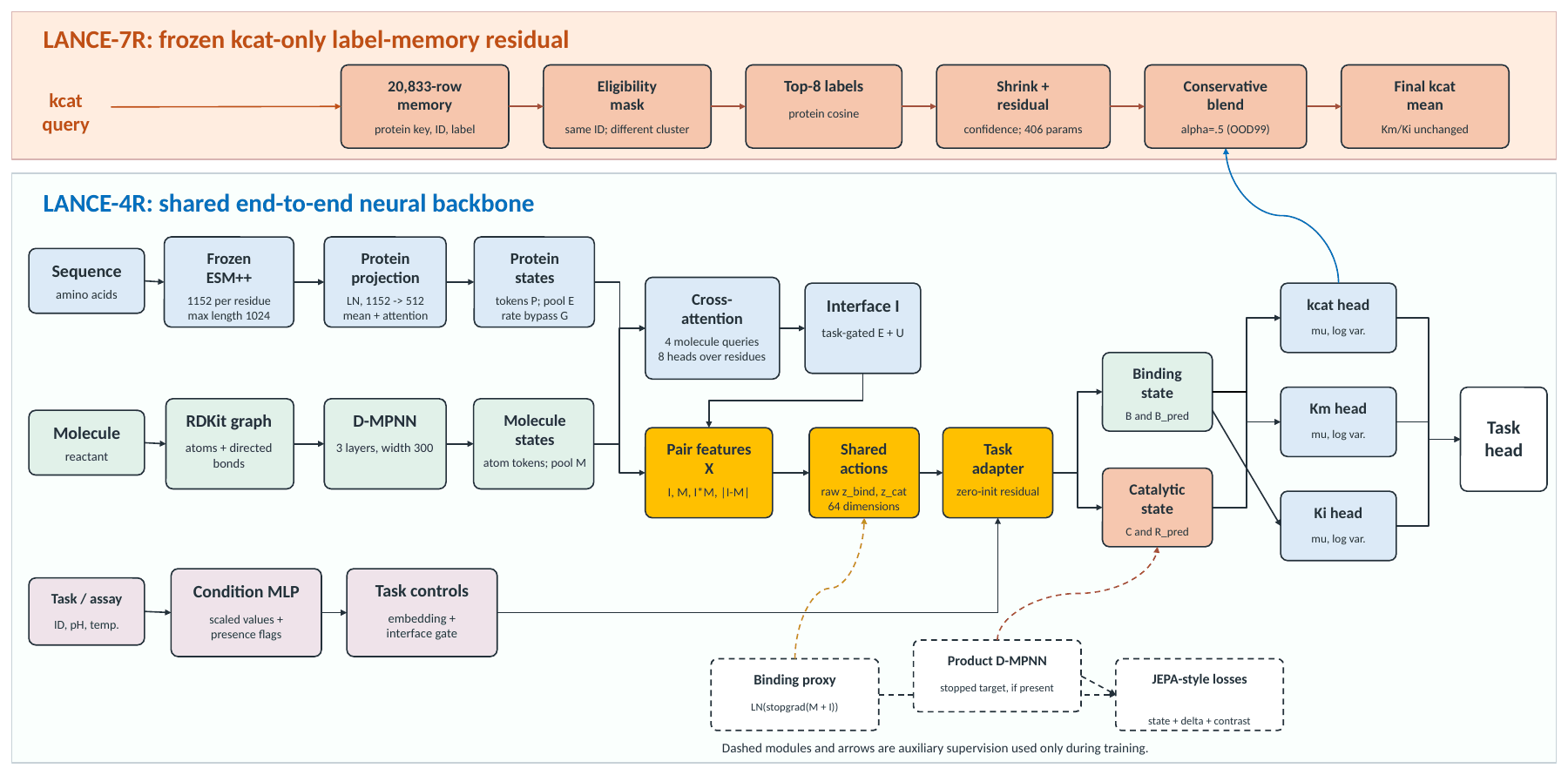
LANCE-7R vs. CatPred
We retrained CatPred v1.0.0 on the same CatPred-DB split using ten independent runs per task and evaluated both systems on exactly matched rows.
LANCE-7R has favorable point estimates in 18 of 18 Heldout/OOD99 comparisons and 41 of 48 comparisons across all supplied Heldout and sequence-OOD cohorts.
On the 348-row turnover OOD99 cohort, R^2 improves from 0.323 to 0.395 and MAE falls from 1.024 to 0.979. On 1,193 held-out inhibition measurements, MAE falls from 0.865 to 0.788. These results measure the complete system; they do not establish how much of the gain comes from either JEPA objective alone.
Heldout/OOD99 scores informed architecture development, so these are development-benchmark comparisons rather than untouched confirmation. Target-specific sequence OOD also does not rule out exposure through another kinetic task in the shared model.
Connecting molecular prediction to drug discovery
Inhibition constants connect enzyme modeling to inhibitor evaluation. LANCE predicts Ki alongside turnover and substrate kinetics from enzyme and molecular features. This makes the work relevant to the computational characterization of enzyme inhibitors in drug discovery.
On 1,193 held-out inhibition measurements, the complete system reduces log10 MAE by 8.9% relative to retrained CatPred, from 0.865 to 0.788, and raises R^2 from 0.633 to 0.674. These are benchmark prediction results; prospective compound screening and experimental validation remain future work.
Bold indicates the better point estimate. n is the number of evaluated rows.
| Target / cohort | CatPred | LANCE-7R |
|---|---|---|
| kcat | Heldoutn = 2,317 | 0.611 | 0.651 |
| kcat | OOD99n = 348 | 0.323 | 0.395 |
| kcat | OOD80n = 306 | 0.271 | 0.341 |
| kcat | OOD60n = 243 | 0.221 | 0.287 |
| kcat | OOD40n = 160 | 0.145 | 0.224 |
| kcat | OOD20n = 104 | 0.126 | 0.157 |
| Km | Heldoutn = 4,117 | 0.649 | 0.672 |
| Km | OOD99n = 479 | 0.540 | 0.549 |
| Km | OOD80n = 380 | 0.551 | 0.560 |
| Km | OOD60n = 282 | 0.549 | 0.553 |
| Km | OOD40n = 173 | 0.483 | 0.474 |
| Ki | Heldoutn = 1,193 | 0.633 | 0.674 |
| Ki | OOD99n = 140 | 0.471 | 0.524 |
| Ki | OOD80n = 122 | 0.382 | 0.433 |
| Ki | OOD60n = 101 | 0.350 | 0.428 |
| Ki | OOD40n = 70 | 0.374 | 0.322 |
| Target / cohort | CatPred | LANCE-7R |
|---|---|---|
| kcat | Heldoutn = 2,317 | 0.701 | 0.657 |
| kcat | OOD99n = 348 | 1.024 | 0.979 |
| kcat | OOD80n = 306 | 1.046 | 1.003 |
| kcat | OOD60n = 243 | 1.117 | 1.075 |
| kcat | OOD40n = 160 | 1.223 | 1.161 |
| kcat | OOD20n = 104 | 1.346 | 1.323 |
| Km | Heldoutn = 4,117 | 0.547 | 0.517 |
| Km | OOD99n = 479 | 0.648 | 0.632 |
| Km | OOD80n = 380 | 0.660 | 0.645 |
| Km | OOD60n = 282 | 0.689 | 0.678 |
| Km | OOD40n = 173 | 0.766 | 0.774 |
| Ki | Heldoutn = 1,193 | 0.865 | 0.788 |
| Ki | OOD99n = 140 | 0.994 | 0.941 |
| Ki | OOD80n = 122 | 1.045 | 1.010 |
| Ki | OOD60n = 101 | 1.051 | 1.008 |
| Ki | OOD40n = 70 | 1.050 | 1.121 |
| Target / cohort | CatPred | LANCE-7R |
|---|---|---|
| kcat | Heldoutn = 2,317 | 77.68 | 80.02 |
| kcat | OOD99n = 348 | 61.81 | 62.36 |
| kcat | OOD80n = 306 | 61.37 | 61.44 |
| kcat | OOD60n = 243 | 58.27 | 58.02 |
| kcat | OOD40n = 160 | 54.44 | 55.62 |
| kcat | OOD20n = 104 | 49.13 | 48.08 |
| Km | Heldoutn = 4,117 | 84.63 | 85.94 |
| Km | OOD99n = 479 | 79.46 | 79.96 |
| Km | OOD80n = 380 | 77.82 | 78.68 |
| Km | OOD60n = 282 | 75.07 | 76.24 |
| Km | OOD40n = 173 | 70.46 | 71.10 |
| Ki | Heldoutn = 1,193 | 67.75 | 71.58 |
| Ki | OOD99n = 140 | 58.86 | 63.57 |
| Ki | OOD80n = 122 | 55.57 | 59.84 |
| Ki | OOD60n = 101 | 57.23 | 59.41 |
| Ki | OOD40n = 70 | 56.71 | 54.29 |
CatPred: mean of ten outer ensembles. LANCE-7R: one selected ten-member ensemble. R^2 and MAE use log10 targets; P1mag (within 10x) is the percentage with absolute log10 error below 1. OOD labels are the supplied target-specific sequence-identity cohorts; Km and Ki have no supplied OOD20 rows. Counts summarize metric directions across nested cohorts, not statistical significance.
Testing what drives the gains
A stronger complete model does not tell us which objectives help. My new study holds the architecture, parameter count, data protocol, and training schedule fixed while changing only the loss coefficients. Each condition uses two paired seeds and 150 epochs: 12 backbone training runs in total, submitted through Slurm on UMD's Zaratan HPC cluster.
- Kinetic supervision only: the full architecture with auxiliary losses disabled.
- Binding JEPA: kinetic supervision plus the binding objective family.
- Reaction JEPA: kinetic supervision plus the reaction objective family.
- Both JEPA branches: tests their combined contribution and interaction.
- Both branches + SIGReg: tests the representation regularizer.
- Full loss recipe: tests the remaining auxiliary objectives as a group.
I separated checkpoint selection, memory calibration, and final reporting into three groups disjoint by pooled 99% sequence cluster. Comparisons use the same report rows and paired seeds, with each kinetic target reported separately. Released test and OOD labels are not loaded by this study; the new report groups may still be sequence-similar to training data.
The full-loss checkpoints also support three memory comparisons: no memory, a simple exact-label average, and learned retrieval. These reuse the same backbones, exclude neighbors in the query's target-specific 99% sequence cluster, and preserve the other two kinetic outputs.
Local checks cover all six configurations, matching initial weights, finite gradients, small end-to-end runs, retrieval exclusions, and Slurm submission and resume behavior. These validate the implementation; the full study has no results to report yet. Two seeds provide an initial repeatability check. This study tests loss contributions, not whether the learned representations are physical binding or catalytic states.